
In those days, when drainage systems were being built at a rapid pace, the ditches were as straight as if they had been drawn with a ruler. No plants or trees grew on the banks, as this made it easier to maintain the ditches with machines. The land improvement systems were large – some even covered the entire area of a sovkhoz. The ditches were maintained frequently so that fields could be cultivated in wet areas and forests could grow faster. Food was needed for both people and animals, as well as wood for heating and construction.
As time passed, however, maintenance took a back seat. The ditches became overgrown, the drainage outlets were buried under sediment, and the farmland became wetter again. Farming became more difficult and many grasslands became forested.
When the land got new owners, the large systems were divided among many landowners. Some of them were interested in both farming and forestry. The state realized that, from the point of view of food production, it was important to keep some of the fields arable and the forests manageable, and came to the rescue with land improvement subsidies. The more enterprising landowners took advantage of this opportunity, and RMK began to actively repair ditches in state forests, reconstructing approximately 1–2% of the total area of drainage systems each year.
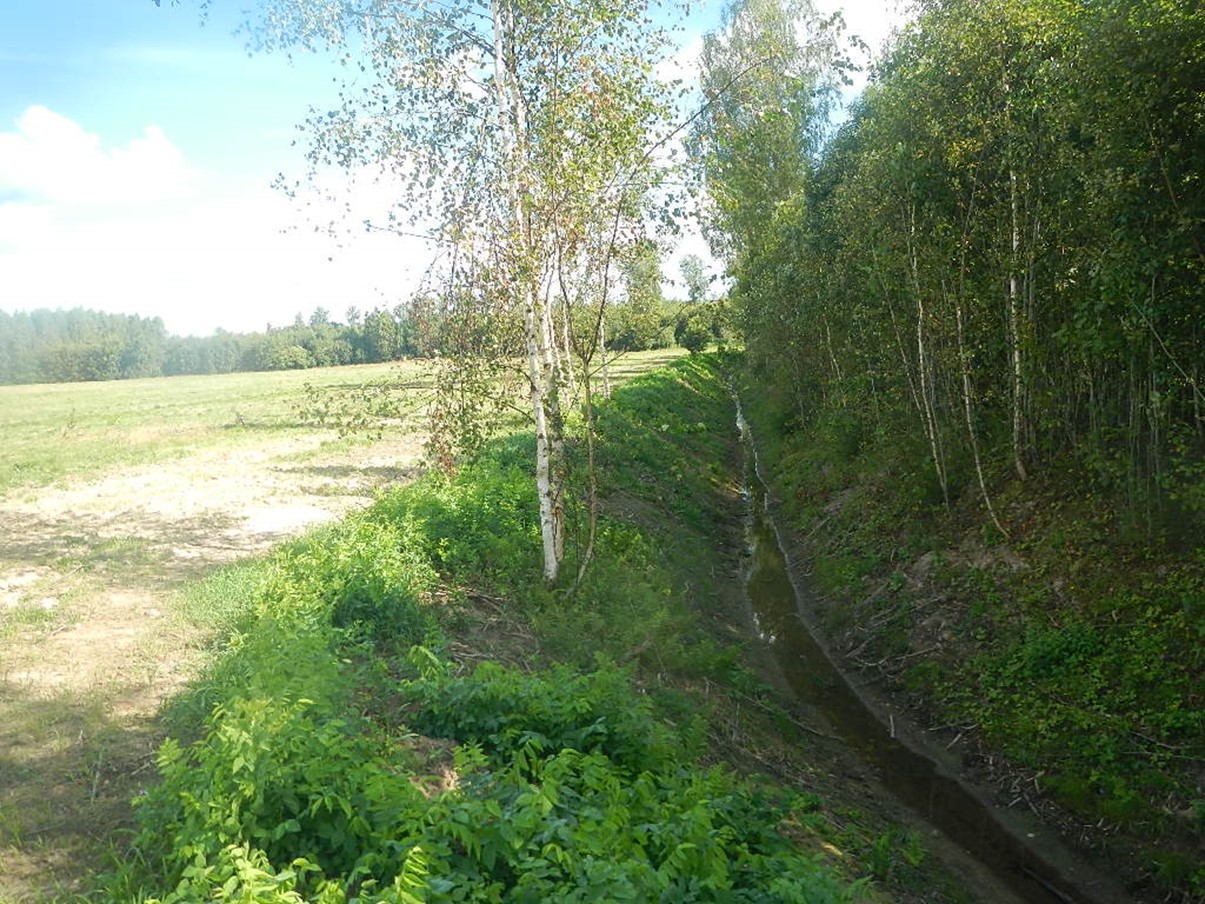
Recently repaired drainage ditch.
This work was urgently needed, as decades of maintenance had left the ditches in poor condition. Farmers who managed to repair the systems on their land have nothing to fear, even in a rainy year. When the drainage ditches and outlets are in good working order, major floods quickly recede. However, where the ditches were not repaired, it was even necessary to navigate between the strawberry fields by boat in the summer – such images were shared on social media and shown on the news.
Focus shifts from reconstruction to maintenance
By now, the great interest in reconstruction has subsided. Attention has shifted to maintenance work, because it is the maintenance of headwaters that helps to mitigate the increasingly frequent heavy rains. Work must be done as much as necessary, but as little as possible – so that the system functions while disturbing aquatic life as little as possible. Large-scale and costly reconstruction work is only carried out when absolutely necessary.
Land improvement systems are mostly self-flowing: water moves from higher to lower levels without pumping. Even a small obstacle – dense vegetation, a beaver dam, or a culvert that is too narrow – can cause the water level to rise over a distance of several kilometers.
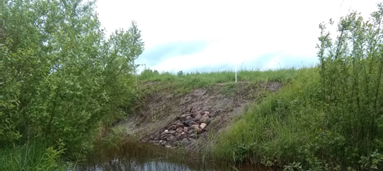
The drainage ditch has been cleaned up and the brush around the mouth has been removed.
Over time, the appearance of the ditches has changed.
They are no longer straight as an arrow – nor will they be for long. So-called two-level ditches have emerged: during drier periods, water flows in a narrow channel, but during high water, it fills a wider bed. There may also be some deeper hollows at the bottom of the ditch where water remains longer. It is important that the water from the drains can flow out during the growing season. During maintenance work, vegetation can be left to grow on one side, but the drain outlets must be kept clean – tree roots tend to clog the pipes. It is also advisable to keep the ditch slopes gentle to reduce the risk of erosion.
When and how to perform maintenance?
It is most reasonable to perform land improvement work during dry periods. Each landowner can assess which tasks are unavoidable and perform some of them themselves:
- remove debris and material accumulated during high water from culverts,
- locate drainage outlets and clean them of sediment,
- clean drainage wells of sediment and cover the wells with lids,
- remove fallen trees and beaver dams from ditches.
If the work exceeds your capabilities, you can apply for support from PRIA – for the renovation of headwaters, the construction of environmental protection facilities, and, if necessary, reconstruction. According to landowners, support for the renovation of headwaters is one of the measures that requires the least amount of paperwork.
In conclusion
Land improvement systems are valuable to land users – they help keep fields arable and forests manageable in different weather conditions. To preserve these values, the systems must be maintained.
Loomise kuupäev: 13.11.2025
